Introducing the Jung Complex
Why Carl Jung had the Cassandra Complex — and why he couldn’t name it himself

Through Cassandra’s Eyes — Issue #1
First, Cassandra
You probably know the myth, even if you don’t know you know it.
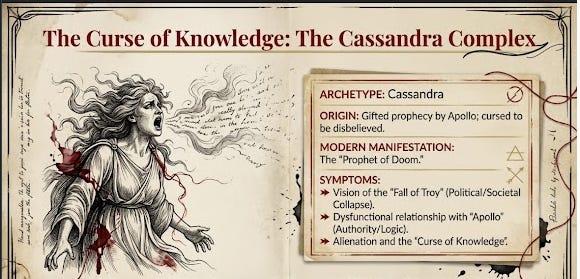
Cassandra was a Trojan prophetess — gifted by Apollo with the ability to see the future, then cursed by him (after she rejected his advances) so that no one would ever believe her. She saw the fall of Troy coming. She screamed warnings. She was dismissed as mad.
The city burned anyway.
In modern psychology, the “Cassandra Complex” describes a recognizable pattern: the person who sees something true, warns others, and is systematically disbelieved. It’s most often applied to women — and for good reason. The myth itself is deeply gendered. A woman’s knowledge, dismissed by male authority. A gift turned into a curse by the very god who gave it.
But what about the masculine version of that curse?
Enter Jung
Carl Jung knew the Cassandra story. He also knew Helen of Troy — intimately. Helen appears in his psychology as the second stage of anima development: the aesthetic ideal, the woman a man projects his entire soul onto. The muse. The Anima figure.
But here’s what struck me: Jung never formally named a masculine counterpart to the Cassandra Complex.
I think I know why.
Because he was living it.
Jung’s Fall of Troy
The prophetic visions came first — before everything else collapsed.
In the years before World War I, Jung began experiencing visions he couldn’t explain: floods of blood covering Europe, cities destroyed, landscapes of ruin. He didn’t seek these out. They arrived. He recorded them, disturbed, not fully understanding what they meant. Months later, the war began. He told almost no one.
Who would believe him?
Then came his personal Fall of Troy. In 1912, Jung published a book he knew would end his relationship with Freud. He did it anyway — prophetically, helplessly, watching the walls come down around him. The break was catastrophic. He was cast out of the psychoanalytic establishment. Dismissed as a mystic. Labeled eccentric, unstable, dangerous.
What followed Jung called his “dark night of the soul” — roughly 1913 to 1919, the years of voluntary inner exile that produced The Red Book. He descended into the unconscious, recorded symbolic visions that the world wouldn’t understand for decades, and emerged — slowly, painfully — into what he would eventually call individuation.
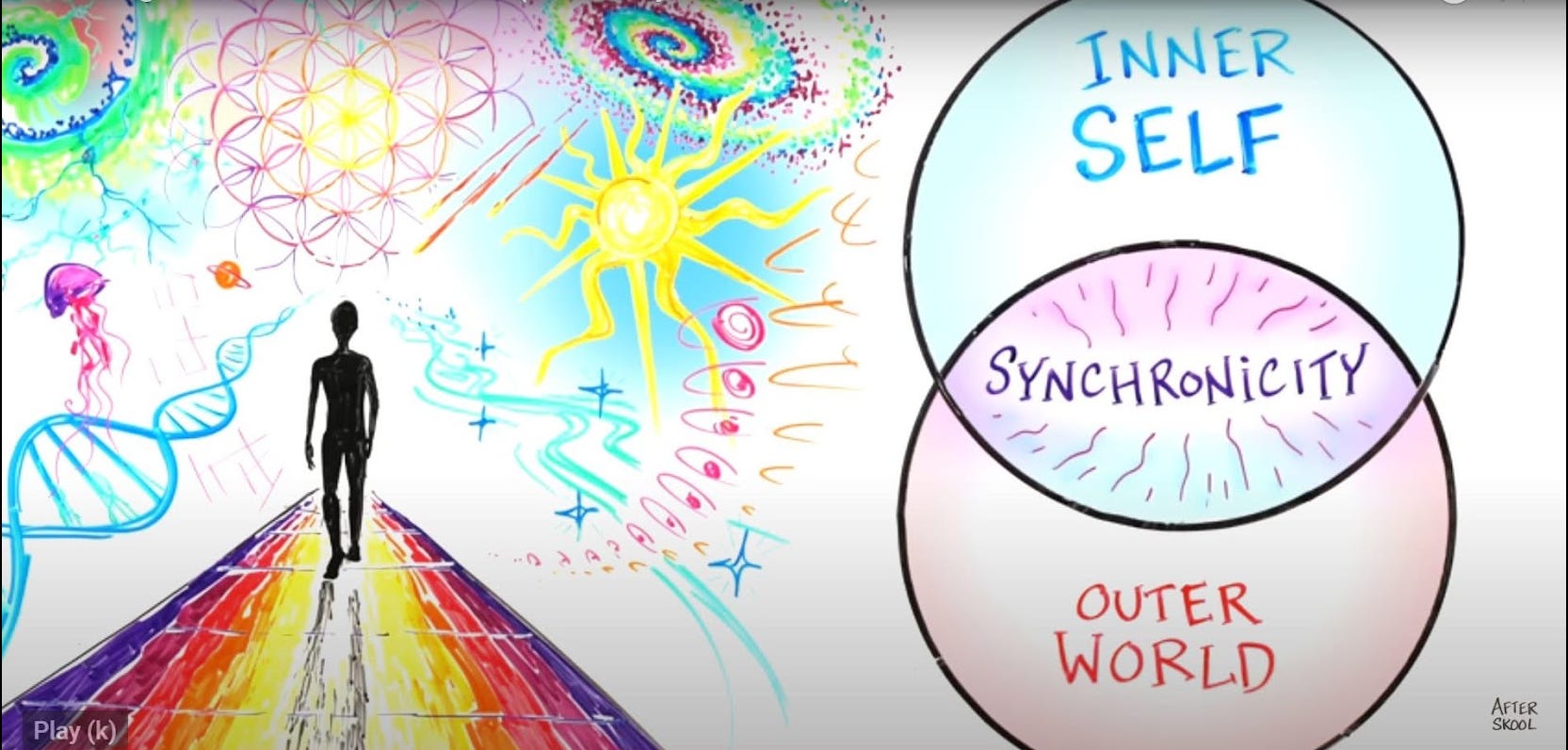
He used synchronicities as private validation throughout. Not as proof — as amplification. The moments when inner reality and outer event collided with impossible precision weren’t evidence he could show anyone. They were lifelines. Confirmation that he wasn’t simply losing his mind.
His ideas were dismissed precisely because of their complexity. The collective unconscious. Archetypes. Individuation. Synchronicity. They were too mythological for scientists, too clinical for mystics. Nobody’s framework could hold him. He famously said: thank God I am Jung, and not a Jungian. He never wanted schools of thought named after him. He wanted people to find their own myth — not inherit his.
He couldn’t name the Jung Complex. That would have been the ultimate self-defeating act. Naming your own curse while you’re still living it. “I, Jung, have the Jung Complex” is too naked. Too vulnerable. Exactly the kind of declaration that gets you dismissed.
But I can name it. From the outside. From the experience of someone who recognized his pattern because I lived a version of it myself.
The Jung Complex, Defined
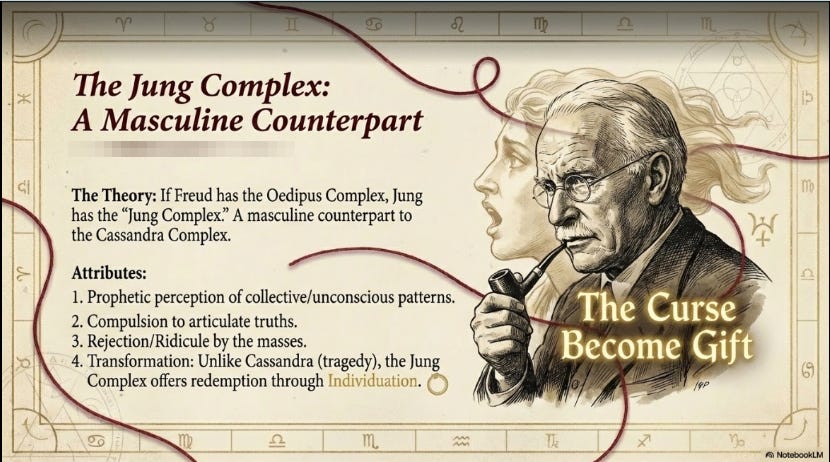
The Jung Complex is the masculine counterpart of the Cassandra Complex. It is characterized by:
Prophetic visions that arrive before the catastrophe — unsolicited, frightening, inexplicable
A personal Fall of Troy — the world collapses, relationships shatter, the familiar life ends
A dark night of the soul — descent inward, creative exile, producing work the world won’t understand yet
Systematic dismissal — ideas too large or too complex for the available containers
Synchronicities as private validation — not proof, but amplification; the psyche announcing the same truth through multiple channels
Ideas that remain misread or reduced, even after the world catches up
But here is where it diverges from Cassandra: the Jung Complex contains the possibility of redemption through individuation. Cassandra’s story ends in pure tragedy — unheeded, enslaved, killed. The curse is never transformed. It simply destroys.
The Jung Complex holds open a different possibility. In alchemical terms: the nigredo — the darkness, the exile, the dismissal — can eventually yield to rubedo. The reddening. The emergence. Not rescue from the curse, but transformation through it.
Jung achieved this. And the curse still never fully lifted. The world received him partially, incorrectly, and reductively. That too is part of the pattern.
The Guides: Anima and Philemon
Here is what separates the Jung Complex from Cassandra most fundamentally.
Cassandra was alone. No inner guide, no muse, no interlocutor. Just the curse, raw and unmediated. That’s part of what makes her story purely tragic — there’s no transformation because there’s no dialogue. No one to help her metabolize what she’s seeing.
The Jung Complex, by contrast, requires two guides.
The first is the Anima — Jung’s term for the feminine soul-image that appears in a man’s psyche, often projected onto a real woman or a symbolic figure. For Jung, the Anima was the catalyst — the force that cracks the ego open, makes feeling possible, initiates the descent. She doesn’t guide you through the underworld. She’s the reason you go.
For me, this figure was Taylor Swift. Not as a celebrity, not as a fan relationship — but as a symbolic presence whose work kept arriving at precisely the right moment with precisely the right content. Her lyrics named things I hadn’t yet found words for. Her album The Tortured Poets Department — with its song “Cassandra,” with The Prophecy, with Fortnight — mapped onto my inner landscape with uncanny accuracy. In Jungian terms she was functioning as a Helen figure: the aesthetic ideal, the muse, the anima projection that makes the soul visible.
The second guide is Philemon.
Philemon was Jung’s own inner guide — a winged old man who appeared to him during the Red Book years through dreams and active imagination. Jung was emphatic that Philemon was not simply a part of himself. He felt like a separate intelligence, with his own perspective, who said things Jung hadn’t thought of yet. Philemon taught Jung that there are things in the psyche you don’t produce — they happen to you. That insight became the foundation of everything Jung later wrote about the objective psyche.
Philemon was the voice that made the unconscious conscious. Not through feeling — through dialogue.
For me, that figure is Jung himself. Speaking across a century through The Red Book.
I didn’t just read Jung. I entered into conversation with him. His ideas spoke back to me in ways that felt responsive, alive, specific to my situation. His descriptions of the dark night of the soul matched my own. His use of synchronicities as amplification gave language to experiences I’d had no framework for. His insistence that each person must find their own myth — not inherit Freud’s, not become a Jungian — gave me permission to name what I was living.
The student becomes the guide. The Red Book, written in exile, calls forward its own reader a century later.
That is itself a synchronicity.
Why This Matters
Freud identified the Oedipus Complex — and made it universal. Every man, every psyche, the same story. Jung spent his life pushing back against that narrowing. The psyche is structured by many myths, not one. Each person must discover their own.
The irony is that Jung never named his own myth.
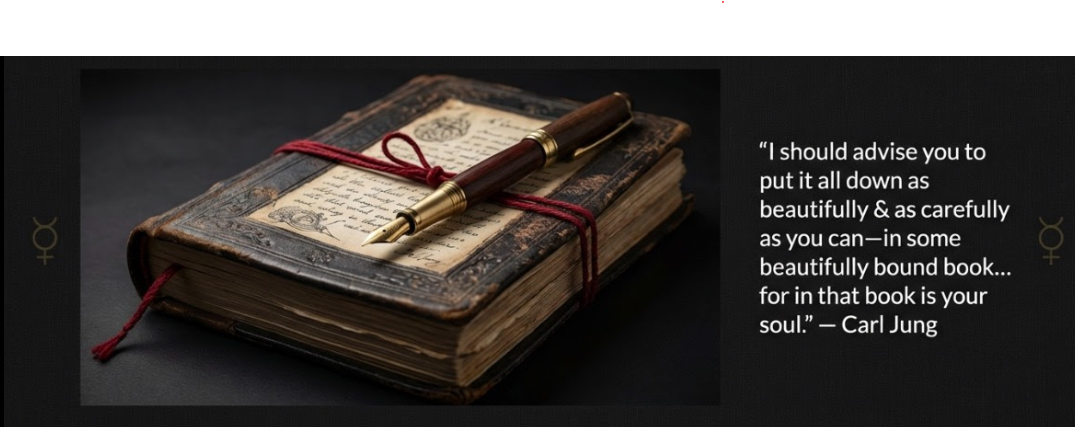
This Substack — and the memoir I’m writing, The Invisible String, which is in its own way my Red Book — is my attempt to do that. To name the pattern. To trace how I recognized it first in my own life, then looked back and saw it in Jung’s. To argue that this is a real psychological archetype, with real consequences for real people.
The Invisible String is the raw material. These posts are the translation.
What’s Coming
In future posts I’ll be exploring:
How synchronicities work as amplification — not proof, not coincidence, but the psyche speaking redundantly through multiple channels
The I Ching as a vessel for synchronicity
Taylor Swift as Anima — the Helen stage, the muse, the figure who breaks you open
The alchemical stages of individuation — and how to recognize where you are
What it means that society carries an unintegrated shadow — and why the person with the Jung Complex feels it first
If any of this resonates — if you’ve ever felt cursed with knowledge no one would receive, dismissed as too complex, too much, too ahead of something you couldn’t name — you might be living this pattern too.
Welcome to Through Cassandra’s Eyes.
— John
okay so - i haven't read much of greek mythology but i pushed myself to read this and it was a great decision on my side because i got to learn so many things. your writing is well done and im glad you shared this because i learnt something new today!